
Why is our gross margin lower than the orders said it would be?
Short answer
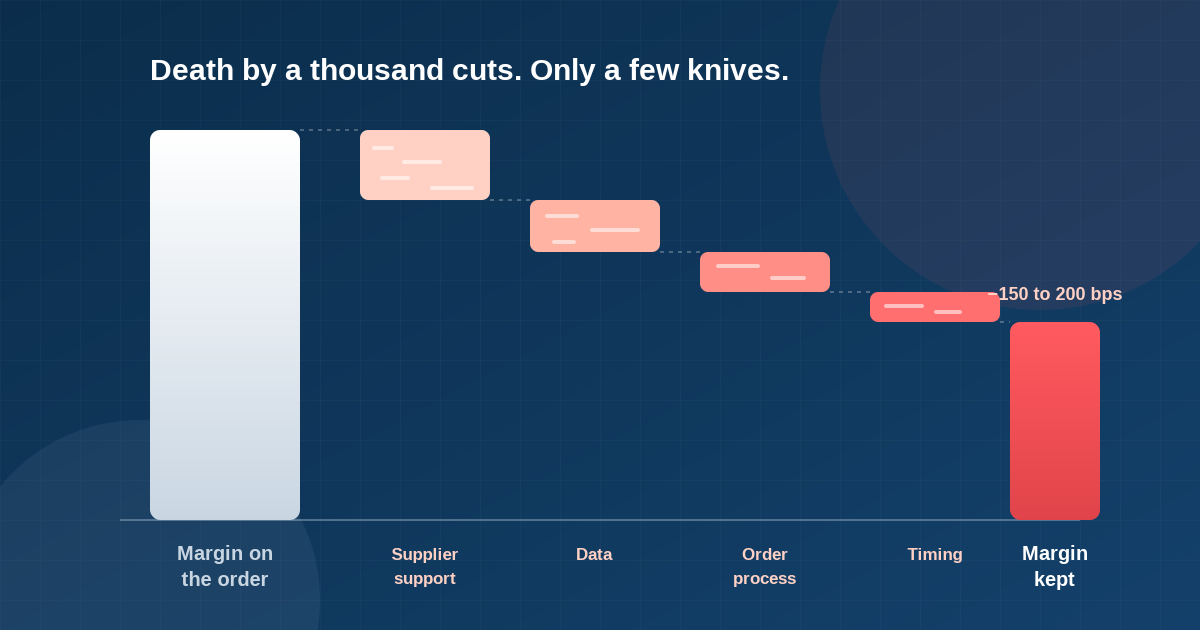
Margin leakage in distribution is rarely one big problem. It is thousands of small disagreements between the margin on the order and the margin on actual cost, and they come from a handful of causes: supplier support that is not accrued or claimed, bad item and price data, and costs that change between quote, order and invoice. A meeting can only review a sample, so most of it stays undiscovered. Analysing every line takes automation. Once you can see every line, a few underlying causes can be fixed at the foundation and the rest checked continuously.
I call it death by a thousand cuts. The good news is that there are only a few knives.Soren Harner, CEO of JotVision
Why should a CFO or VP of Strategy care about margin leakage?
Because it is the closest thing to free money a distributor has. It is profit you already earned on orders you already won, and recovering it needs no price increase and no new customer.
The arithmetic is unforgiving in both directions. Average EBITDA in many distribution verticals is about 4% of sales. McKinsey’s analysis of 140 public distributors found that a 1% change in price moves EBITDA margin by more than 22%. A point of margin lost between the order and the invoice does the same damage as a point of price, and nobody decided to give it away.
The size of the prize is consistent across sources. A 2026 report by Distribution Strategy Group and Cavallo estimates the recoverable gap at 150 to 200 basis points, or $750,000 to $1 million a year at a $50 million distributor. An older study of 2 electrical distributors, with $164 million and $198 million in sales, found they gained 1.0 to 1.84 points of gross margin after cleaning up their product and price data. That study is from 2005. The problem is not new.
It lands on the CFO or the head of strategy because nobody else owns it. As Scott Sinning, former VP of Pricing Strategy at Graybar, puts it: “Cost increases fail at the handoffs between purchasing, pricing, sales, and finance.” Each department does its part. The margin is lost in between.
How does margin leakage show up in the business?
It shows up as symptoms long before it shows up as a number.
Every invoice line has 2 margins:
Based on the cost someone expected when the order was entered.
What finance sees after the goods ship.
At a mid-size distributor, thousands of lines a month disagree. Most disagree by a little. Some turn a healthy order into a loss. The symptoms are familiar:
- Month-end margin comes in below what sales booked.
- Credits and rebills are routine.
- Someone on the pricing team spends their days on manual accruals.
- Supplier claims sit unreconciled for months. Reconciliation cycles for special pricing run 3 to 6 months.
- The data team is permanently behind.
- The ERP carries years of custom rules and scheduled jobs that nobody can fully explain.
Eventually someone starts a meeting. In my experience it is usually a newly arrived executive who decides to count what everyone else had learned to live with. I have sat in these reviews. The group discusses one invoice line while 2 or 3 people from pricing look things up in the ERP: purchase history, the item’s audit trail, the price page, the contract, the quote. They get through a handful of lines in an hour.
That is the limit of the meeting, and it matters. A meeting samples. The lines it never reaches can hide whole causes that nobody has seen yet, and any ranking of causes is only as good as the sample. You cannot get the scale to really analyse the problem without automation. Most distributors do not have it: 63% still use Excel for profitability analysis, and only 34% give sales real-time profitability data.
What causes margin leakage?
About 8 causes, in 4 groups. None of them is exotic.
The evidence for the first group is the strongest. Deloitte writes that “SPA dollars for a distributor are often larger than net income dollars” and that “most distributors do not have adequate SPA management systems.” Enable, which sells rebate software, says that ERP systems “generally cannot cope with the level of complexity involved in rebate deals.”
The data group has been measured for 2 decades. In 2004 an electrical-industry study found that 60% of manufacturers’ items did not match the records in their distributors’ systems, and the 2005 study above found wrong units of measure and missing costs among the errors.
The order-process group is less studied. The 2026 survey found that 38% of orders need manual pricing intervention. One ERP vendor estimates that distributors lose 3% to 8% of gross margin on non-stock items when purchase orders are created by hand and lose their link to the customer order. On acquisitions, David Bauders of SPARXiQ notes that merged organizations usually keep separate systems and inconsistent pricing.
On timing, a mid-2026 Baird and NAW survey of smaller distributors found that 91% raise prices when costs rise but a third absorb part of the increase. Building-materials dealers told LBM Journal they hold quotes for anywhere from 5 days to 3 weeks; one distributor said, “In most cases we are having to eat the increase due to our long order file.” And pricing consultant Lee Nyari explains how an average inventory cost that lags the supplier’s current cost makes a margin look healthier, or worse, than it is.
Some of these misses correct themselves when the supplier’s credit lands. Others are money gone. From the outside they look the same, which is part of why so few get chased.
3 things I have learned about this list
- It follows a Pareto curve. 2 or 3 causes produce most of the misses.
- What you see first are symptoms. You have to peel back the layers, asking why 5 times, to reach what is underneath. When you do, several symptoms often turn out to share one root, such as an ERP that accrues supplier support on a different basis from the one the supplier uses.
- The low-hanging fruit is real, but you find it only after that analysis. Fixing symptoms one at a time is how the custom rules and scheduled jobs pile up.
Is margin leakage normal for distributors?
Yes. The causes above are documented across the industry, some of them since 2004, though not equally well. Supplier support and data quality have surveys and studies behind them. The order-process and timing causes show up mostly in trade articles and in the experience of people who have sat in these reviews. Distribution Strategy Group, after surveying more than 200 distribution executives in 2026, called it “an operating discipline problem” and said the margin is “already inside your four walls.”
What is rare is measuring it.
What can be done about margin leakage?
Work in 3 stages. The order matters.
Get situational awareness
- Give it one owner across the handoffs. Sinning’s rule for special pricing applies to all of it: “if you don’t govern the full lifecycle, you’ll negotiate margin upstream and give it back downstream.”
- Measure the 2 margins on every invoice line and record each miss by cause, automatically. One distributor’s automated scan surfaced 709 below-cost transactions that standard reporting had missed.
- Rank the causes, then peel the top ones back to what is underneath.
Lay the foundation
- Fix the underlying causes once. That means data where it enters the business (supplier price files, contracts, units of measure) and the logic the ERP gets wrong (how supplier support is accrued).
- Stop adding patches. Every new rule or scheduled job is one more thing nobody will understand in 5 years. Own the logic you keep.
Keep it closed
- Check orders as they are entered. Think of it as spell-check for sales orders: it flags a cost that does not match the purchase order, an expired contract or a missing unit conversion while the order can still be fixed. Then run a first pass on every miss overnight, so the meeting spends its hour on decisions and not on lookups.
- Take the clean-up off people: accruals, credits and rebills, contract renewals.
Continuous checking matters because the business does not stand still. A new supplier, a changed rebate rule, a new hire at the order desk or a fix that quietly stops working will each open a new leak. A project closes the causes you found. Only a check that runs every day catches the ones that arrive next.
Pricing software, rebate software and pricing consultants all have a place here. Pricing software sets better prices and rebate software keeps claims in one place, but both assume clean inputs and a team to run them. Neither knows how your ERP behaves when a contract expires. And a consulting project ends; the discipline has to survive without it.
How can JotVision help?
The problems are the same from one distributor to the next. The systems, the suppliers’ rules and the history are not. A product cannot know those details, and a one-time custom build will not keep up with them.
So we start with the analysis, on every line and not a sample. We get to the underlying causes, lay the foundation on your systems, and then keep operating it. Your people approve the changes. Your ERP stays the system of record.
We build and operate these workflows for each customer:
- Supplier price and contract updates, validated and written into the ERP
- Ship-and-debit claims, prepared and reconciled by each supplier’s rules
- Price-page and catalog audits, with leadership reporting
- Self-service ordering for small orders
- Supplier-support accruals calculated the way each supplier pays
- Order-entry margin checks
- An overnight first pass at root cause on every missed line
- Clean-up packages prepared for approval
Running in production today at a $1B+ automation distributorAlso built and operated for customers

Is your margin lower than your orders said it would be?
Book a free 30-minute consultation. I will be on the call.
Book a free consultation →Definitions
FAQs
What is margin leakage in distribution?
The gap between the margin expected on an order and the margin actually kept, caused by cost, contract and data errors between quote and invoice.
How much margin do distributors lose to leakage?
Published estimates put it at 150 to 200 basis points.
Why is the margin on my invoice different from the margin on the order?
The order uses an expected cost; the invoice uses actual cost. They split when supplier support isn’t accrued, a contract expires, a unit of measure is wrong or the cost changes after order entry.
Can pricing software fix margin leakage?
Only partly. It sets better prices, but it doesn’t fix supplier cost files, contract setup or ERP accrual logic, where most leakage starts.
Who should own margin leakage?
One executive with authority across purchasing, pricing, sales, and finance, usually the CFO or head of strategy.